Thursday, 9 August 2012

Tamlaght O' Crilly "Upper "


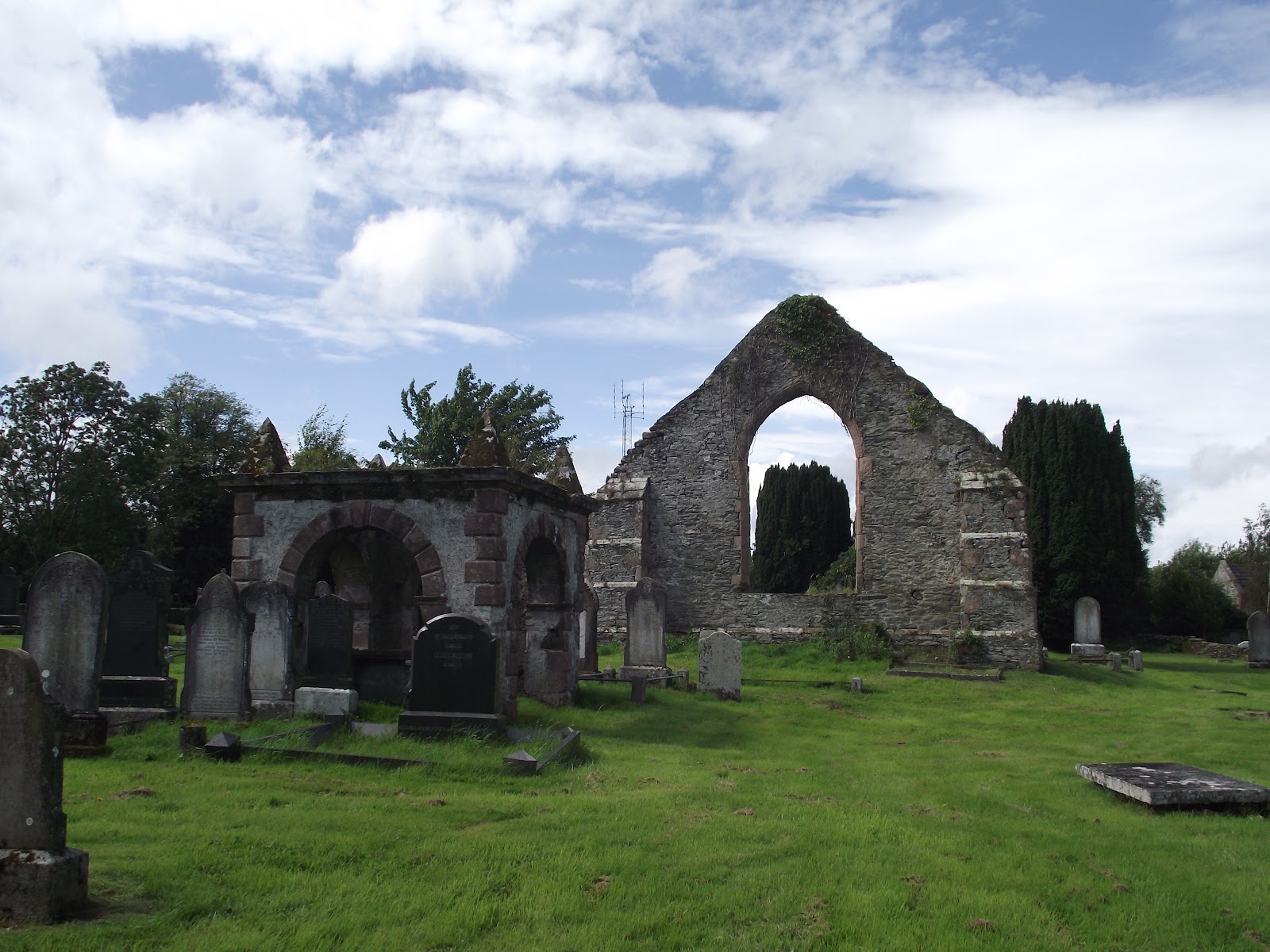
Tamlaght O' Crilly, "the plague monument of the O'Crillys", is a parish in east County Derry, close to Portglenone. The O'Crillys were herenarchs, (agents or stewards), of the church lands in the area in the Middle Agents. The monument is supposed to be the burial cave on rising ground above Tamlaght village. There was a church in ancient times.


The church was roofless in 1622, though otherwise, in good repair. It was ruined in the 1641 Rebellion, and remained so throughout the reminder of the 17th century. By the 1768 survey, the church was in good repair. In 1775, the parish was divided into Tamlaght O'Crilly Upper and Lower.


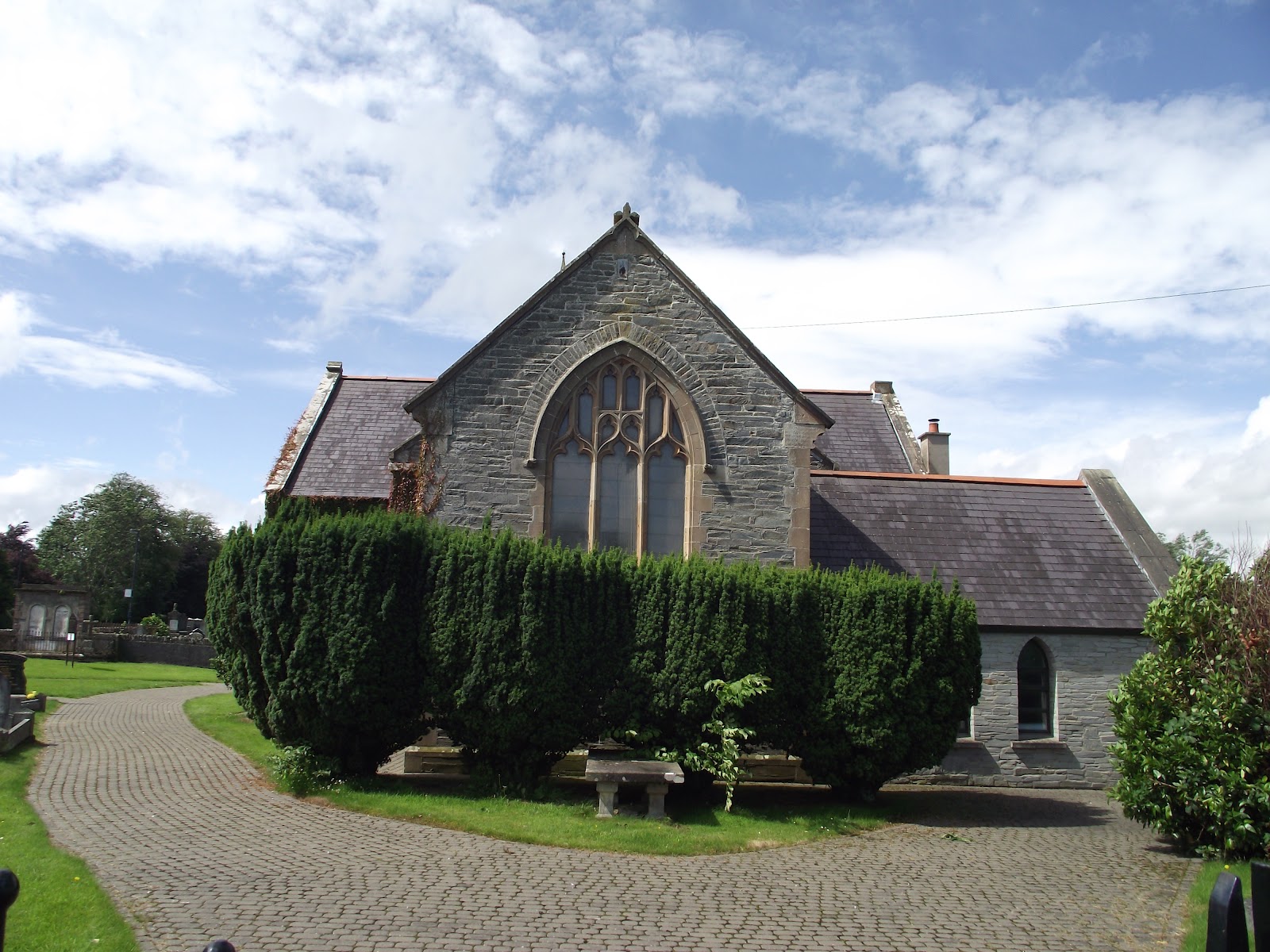
Tamlaght O'Crilly Upper Church is in Tamlaght O'Crilly village in Co. Londonderry, sixteen kilometres east of Maghera. The church was rebuilt in 1815, and the chancel dates from 1859. It is entred through the porch which is at the base of a louvered tower.


The interior entrance door is in memory of Arthur McCay, and James and Sarah Michael, 1980, and there is a window of coloured lattice glass in the tower.


There are three windows in the south wall, each of which has coloured lattice glass and Y tracery and no windows in the north wall.


The east window has three lights and tracery , Our Lord is in the centre, with praying figures on either side. The window commemorates Katherine Francis, wife of Canon Robert McQuaide, Rector of Tamlaght O'Crilly Upper, 1909-1956. She died in 1935. There is a small window in the south wall of the chancel.


In the sanctuary, the stone reredos behind the Holy Table commemorates Godfrey Samuel, Alicia Greene and Godfrey Greene.  The east wall is panelled in stone, which extends both sides of the reredos. The first of the three sections commemorates Thomas McKay, the second, those who fell in the Great War, and the third, L.Cpl. Alston Neely who was killed in action 1918. Similarly, the three sections to the right of the Holy Table commemorate, first, William and Margery Kernaghan, second, Alice Crockett. Over the whole reredos are carved the words, "Blessing and Honour and Glory and Power be unto the Lamb". The vestry room is to the left of the chancel.


The baptistery and font are in the north-east corner of the nave. They commemorate the Rev. Henry Innes Law, Rector 1957-1963. The pulpit on the left commemorates both Canon McQuaide and the Rev. H. I. Law. The lectern is in memory of James Lennox and his son John, 1964. The prayer desk and chair in the chancel were presented by past and present parishioners, 1960. There are some chairs in the sanctuary. One of these commemorates the Rev. Maiben Cunningham Motherwell, Curate from 1826 to 1854. Another chair is in memory of Thomas and Sarah Crockett, 1960. The credence table is in memory of William and Margaret Neely, 1971. A plaque states that the Communion kneelers are in memory of Samuel and Mary McClintock and Bessie Nelson, 1995. There is a one manual Telford and Telford organ with pedals. On hymn board was presented by St. James' Church, Belfast, 1958, and the other is in memory of Bobby McClintock.


Monday, 6 August 2012

Flahertach O' Brolchain and the Origins of the Diocesan System


The Diocesan system which exists in Ireland today was established following the Synod of Rathbreasil in 1111. It was consolidated at the Synod of Kells in 1152, and the Synod of Cashel in 1172. These Synods were held to bring the Celtic Church into line with the Continental mainstream from which it had drifted considerably. Hitherto, there had not been dioceses and parishes as we now know them. The Celtic Church was structured around the many monasteries with their abbots as the head of the community. The bishops who ordained the clergy lived within the monasteries and were subject to the abbots. By 1100, the abbots of the monasteries had become powerful landlords, and the spiritual life of the monasteries was in decline. Reform was necessary.

In the north-west, St. Eugene founded the "Diocese" of Ardstraw about 540. This survived until about 1150 when Bishop Maurice O' Coffey transferred the See to his native Rath Luairg, Maghera. Maghera in turn survived until about 1280 when the See was transferred to Derry.

Though Maghera was the site of the See from c1150 to c1280, nevertheless, Derry during this period had an abbey which had originated in Columba's time. In 1164, the Teampaill Mor, or Large Church, was built to replace Columba's abbey. This abbey had bishops, and was a very important institution. By the twelfth century, bishops were emerging from the monasteries, and they were beginning to acquire jurisdiction over territory which usually coincided with the old tuaths, the ancient kingdoms.

A very important figure at this time was Flahertach O' Brolchain, who, it can be claimed, was the first Bishop of Derry, even though the See was still at Maghera. He was Abbot of Derry, and became bishop in 1158, shortly after Maurice O' Coffey became bishop. His family had supplied many eminent ecclesiastics for the Abbey of Derry. They were sometimes known as O'Brollaghan, or Bradley in English, and they were a distinguished noble family. O' Brolchain was a very powerful character, whose influence was widely felt throughout Ireland.

The Four Masters relate the circumstances of Flahertach O' Brolchain's election as bishop as follows,

"An assembly was held by the Irish clergy at Brigh-mac-Taidhg in the territory of Hy-Laoghaire (in County Meath) at which were present, twenty-five bishops, together with the apostolic legate, for the purpose of establishing ecclesiastical discipline and the improvement of morals. In this assembly the clergy of Ireland and the coarb of St. Patrick (Archbishop of Armagh), decreed by common consent that a bishop's chair (cathaoir easpoicc), and the supreme superintendence of all the abbeys in Ireland, (that is, of the Columban Order), should be given to the coarb of St. Columbkille, Flahertach O' Brolchain. The bishops of Connaught set out on their way to this Synod but they were robbed and beaten, and two of their people were killed by the solders of Dermot O' Melaghlin, King of Meath at the wooden bridge at Clonmacnoise, after they had passed through the town; then they returned home." 

Flahertach O' Brolchain owed his preferment to Gelasius, or Gilla-mac-Liag, who was a leading figure in the 12th century reformation of the Celtic Church. It was largely due to him that the presesnt diocesan system was created, and that the Church at last emerged from the monasteries. 


Arms of the Sees of Derry and Raphoe


It seems that the original arms of the Bishopric of Derry were a figure of St. Columba imparting a blessing. After the time of the Reformation, the arms used were Azure, three episcopal mitres, Or a device  which, it is possible, alluded to the three Dioceses of Derry, Raphoe, and Clougher being held together.

After the Great Siege of 1689, Bishop William King, obtained from Sir Richard Carney, Ulster King-at-Arms, a grant of the Arms which have since been born by the See. These are the same as the See of London, with a harp added.

The Arms of the See of Derry are, Gules; two swords in a saltire proper, the hilts in base Or; on a chief of the Arms of Ireland; Azure; a harp or stringed Argent.

The Arms of the See of Raphoe are, Ermine; a chief per pale Azure and Or; the first changed with the sun in splendour of the last; the second with a cross patee Gules.

Killowen, Coleraine, St John


The Parish of Killowen is one of the smallest in the geographical area in the Diocese of Derry, yet on of the largest in population. Its church which is dedicated to St.John, is situated on the west bank of the River Bann in Coleraine, Co. Derry. The diocesan boundary with Connor Diocese is formed by the river, and the other side of which is the parish of St. Patrick's, Coleraine.


The name Killowen means, "Owen (or Eugene's) Church". The dedication to St.John, which has lasted, is a mis-translation of the Irish. In ancient times, the parish was called Drumtarsi. In 1248, the English erected a castle and a bridge over the Bann. Stones for this castle came from the ancient abbey of St. Carbreus.


At the time of the Plantation, the Clothworkers' Company was established in the area, which then was a county, the County of Coleraine. The name Killowen was given to the parish at this time. In 1622, Killowen Church was, "meanly repayred". In the 1768 survey, it was reported to be in very good repair. The church was converted into a school house in 1830, and in that year, a new church was built with financial assistance from the Clothworkers' Company, the Bishop, the Irish Society and the Board of First Fruits. In 1875, the church was practically rebuilt. The west wall was added, the east wall was partially replaced, and a chancel was added. The side walls were raised, and a new roof was built. The church was consecrated on 27th July 1875.

The vestry room to the left of the chancel, was built in 1927 in memory of Henry Stewart O'Hara, Bishop of Cashel, at the expense of his widow.

Corbel from the North Side of St Anne's Cathedral, Belfast.


Bishop O' Hara was Rector of St.Patrick's, Coleraine from 1869 to 1894, and Bishop of Cashel, 1900-1919. He was largely responsible for the early building of St Anne's Cathedral, Belfast, when Vicar of Belfast, 1894-1900. A plaque is erected in the vestry room of Killowen Church was erected by Mrs O' Hara.

Killowen Church is entered by a small west porch. Inside, the nave is flanked by a south aisle, which on the outside has two gables. The short aisle to the west is lower in height. This contains the baptistry. The font was presented by Robert McCandless. In June 2001, two new stained glass windows in the baptistry were dedicated by Edwin Whyte in memory of his wife Margaret and their daughter Janet. Together, they depict the children coming to Jesus.


At the other end of the aisle, east, is an extension which contains a porch and the organ chamber. The west window has four lights and illustrates the four Evangelists. In the tracery, there is a crest with the Latin inscription, Domine Dirige Nos. In the baptistry in the south aisle, are two small windows with opaque lattice glass. The first window in the aisle also has opaque lattice glass. The other window has three lights. From left to right, the window illustrates, the Flight into Egypt, the Manger Scene, and, Our Lord as a boy in the Temple. This is the anniversary window of the Mother's Union Killowen Branch 2004. Each of the three windows in the north wall has two lights. The first, which was dedicated in 1998, commemorates Jim Oliver. A brass plaque adjacent acknowledges the window. The left side has the text, "He hath ears to hear, let him hear", (St. Mark 4:9), and the right side illustrates the text of Revelation 3:20, "Behold I stand at the door and knock". The middle window commemorates, on the left, members of the 5th Battalion, Ulster Defence Regiment, who fell between 1970 and 1992, and on the right, members of the Royal Ulster Constabulary and Reserve members, 1996. The window on the right depicts Christ, the Resurrection and the Life, and it commemorates Rosemary, wife of the Rev. Alwyn Maconachie, Rector of Killowen, 1947-1964, who died in 1954. The east window depicts the Ascension of our Lord, and it commemorates those who fell in the two World Wars.


In the nave, the pulpit on the right below the chancel, commemorates Bishop O'Hara's wife, Hatton, 1937. There are two cared prayer desks on the left side, and there is a wooden eagle lectern adjacent which commemorates the Rev. W.H. Giles, Rector of Killowen, 1894 to 1923, and Mrs Giles. The Holy Table came from St. Augustine's Church in Londonderry in 1936. The Concher organ has two manuals and pedals. It was built in 1894. It was transferred from the organ loft to the south side of the chancel in 1906. The organ chamber and a reading desk were presented by grandchildren of John Wilson and his wife Catherine who emigrated to America in 1876. The organ stool commemorates Hugh Clements who died in 1998.

  
On the west wall, a monument commemorates Henry Kyle, JP, DL of Laurel Hill who died in 1878. There is a memorial to William Thompson Kyle, his youngest son who died in 1913. On the south wall, his wife Elizabeth who died in 1865, and their son Henry who died in 1866, are commemorated. In the baptistry, a Latin memorial commemorates Elizabeth Todd who died in 1750. The Roll of Honour to those who fell in the Great War is on the east wall of the aisle, and on the south wall, those who fell in the Second World War are commemorated. On the east wall, left of the sanctuary, there is a memorial to the Rev. William Sillito, Curate of Killowen, 1824-1831, and Rector, 1831-1873. He died in 1875. On the east wall, right of the sanctuary, is a memorial to the Rev. Wilfred Courtney Abbott, Curate-in-charge, then Rector of Killowen, 1924-1947. On the north wall of the sanctuary, a brass memorial commemorates Hugh Clements, JP, a former Mayor of Coleraine, who died in 1954. On the north wall there is a memorial to Margaret Emma, wife of the Rev. James Stewart, Rector of Killowen, 1873-1894, during whose incumbency the church was rebuilt. She died in 1884. There is also a memorial to Ann, the wife of the Rt. Hon. Richard Jackson of Jackson Hall Coleraine, daughter of Charles O'Niell of Shane's Castle, Antrim, who died in 1781.


St. Canice, Faughanvale, Eglinton


The pretty little village of Eglinton in Co. Derry, is thirteen kilometres east of Londonderry, just to the south of the Limavady Road. The Parish name of "Faughanvale" derives from the Irish "nua clonghail", new habitation, and has nothing more than coincidence to do with the name of the River Faughan which flows through it. The Patron Saint is Canice who was born about 517 near Limavady, and who died about 600. Canice founded a monastery in the area. He also founded one at Kilkenny, which means Canice's Church.. He was one of the twelve companions of St. Columba on his journey to Iona. In Scotland he was known as St. Kenneth. Ruins of Faughanvale old church can still be seen.


At the time of the Plantation, in 1615, the Grocers' Company of London was granted a manor of 15,900 acres, (6,435 hectares) around the southern shore of  Lough Foyle. The village which grew up was at first called Muff. The Grocers' Company built a new Church on their estate in 1626. This lasted until 1820 when the Grocers' Company decided to replace it with the current church in Eglinton. Its ruins are adjacent the church.


St Canice's Church in Eglinton was completed in 1826 to a design by John Bowden. It was a rectangular, aisle less four bay hall. North and south transepts were added in 1856, and the chancel was built in 1899 by W.E.Scott of Willsborough in memory of his wife and daughter.


The tower is in memory of his wife and daughter. The tower is topped by four pinnacles at the west est. At its base is the porch, inside which are stairs to the gallery and the loft. The main entrance doors are in memory of the Doherty family, 1973, and the bell has an inscription in memory of the Rev. Arthur Dobbs, Rector, 1912-1930. Inside the baptistery is to the right under the gallery, and there is a corresponding space opposite. The pulpit and prayer desk are to the left at the lower chancel entrance, and the prayer desk and lectern are to the right.

The organ, by Evans and Barr, has two manuals and pedals. The console is in the south transept. The marble steps in the chancel and construction of the tower commemorate Thomas and James Gallagher, 1930. The vestry room and other room are to the left of the chancel.


In the south wall, the window, which has two lights and y tracery, illustrates the 23rd Psalm, and in memory of William and Elizabeth Michaels, 1936. Opposite on the north wall, a similar wundow illustrates the encounter on the Emmanus Road, (St. Luke 24:29), in memory of Meta Robert and Thomas Alexander  Michaels, 1936. The window in the south wall of the transept has tracery, and illustrates the Wise Men and the Shepherds at the Manger. It is memory of James Gallagher of Belfast who died in 1929. Opposite, the window in the north wall of the north transept has three lights, and illustrates the Empty Tomb. It is memory of Thomas Gallagher, who died in 1927.


The east window of three lights was given by Katherine Philips in memory of her father, Edward Scott of Willsborough who died in 1913. On the left is St. Peter, St.John is on the right, and our Lord is in the centre.

On the west wall, a plaque records the re hallowing of the church after extensive renovations on the 16th October 1997. Another plaque adjacent records the instillation of electric lighting in memory of Catherina Michaels in 1948. There is a memorial to Winifred Webster who died in 1992, and a plaque records the donation of the carpet in the area opposite the baptistery in memory of Alexander Thompson and his wife Lucinda. The memorials to those who fell in the Great War are on the north wall, and in the porch. On the south wall Major William Quin of Campsie House, who died in 1922, is commemorated.

On the east wall of the south transept, there is a memorial to Anne, second wife of Thomas Scott of Willsborough who died in 1840, and to Katherine, the third wife who died in 1857, and to Thomas Scott himself who died in 1872. Katherine Phillips who died in 1934, is commemorated, and a plaque records the instillation of amplification in memory of the parents of Robert Carson and James Moore in 1984. On the west wall of the north transept, Edmund Leckey of Longfield Lodge, Eglinton who died in 1917 is commemorated, on the east wall, there is a memorial  to the Rev. James Christie, Perpetual Curate of Faughanvale from 1823 until his death in 1846.


In the chancel, on the north wall, there is a memorial to Elizabeth Burnside who founded the Sunday School in the parish, and who died 1907, and on the east wall, a plaque marks the association of the North Irish Brigade with the parish from the 1st April 1960 to the 1st of April 1964. On the south wall of the chancel, there is a memorial to Margaret Davidson who died in 1903, and on the east wall, a brass plaque notes the donation of the hymn board in memory of Mammie Ruth in 1987. In the upper section of the chancel, on the north wall, a monument records the erection of the chancel in 1899 in memory of Georgina  and Annie Scott, wife and daughter of W. E. Scott of Willsborough. Another plaque records the renovations already mentioned in memory of Thomas and James Gallagher, 1930. On the south wall of the inner chancel there is a memorial to John Michaels who died in 1948, and to his brother who died in 1956.


There was a close association between the Parish of Faughanvale and the nearby military airfield in the 1940s and 1950s. In August 1941, during the Second World War, the airfield at Eglinton began to be used as an RAF fighter base. On 1st May 1943, RAF Eglinton was loaned to the Royal Navy, and on the 15th May that year, it was commissioned as HMS Gannet.


To acknowledge worship by personnel of the Royal Naval Air Station of Eglinton from 1943 to 1959, the Ensign and crest of HMS Gannet are on the east wall of the chancel.

There were some distinguished families in the parish as can be seen from the windows and memorials. In 1696, the Rev. Gideon Scott, a chaplain in the army of William III, bought the Willsborough estate in the townland of Donnybrewer in the parish. The name Willsborough derives from the name of the King, who was apparently pleased by the sermon which he had heard Mr. Scott preaching! He was the ancestor of Major W. E. Scott of Willsborough. The Michaels and Gallaghers were benefactors of the church in the 1930s. Mrs Eliza Michaels who died in 1936, was a sister of Thomas Gallagher of the tobacco firm of Gallaghers.


The large and prominent burial monument in the graveyard belongs to the Spencer family who lived in the 18th century. They had a direct ancestral link with the Spencers of Althrop, Northamptonshire, of which family, the late Diana, Princess of Wales, was a member.


Friday, 3 August 2012

St Columb's Cathedral Memorials.


Derry Cathedral contains over eighty monuments, memorials and brass plaques, more than any other Church in Ulster. Quite a few are very fine pieces of classical sculpture. No attempt is made here to describe them all. They are catalogued in a volume which can be seen at the Cathedral Office.


They commemorate Derry's association with the London Guilds and the Irish Society, as well as former bishops, deans, dignitaries, benefactors and famous citizens.


In the porch there are memorials to, amongst others, Thomas Gough, son of Dean Gough who was killed at Sevastopol during the Crimean War in 1855, and to Bishop William Higgin who died in 1867.


In the north aisle, there is the monument to John Elvin, Mayor of Derry, who died in 1676 aged 102 years.


There is the memorial to the Great War, and a monument commemorating the men of the 9th Londonderry Heavy Anti Aircraft Regiment who served in the Second World War.


Another classical monument commemorated Hugo Edwards who died in 1667.