Showing posts with label Londonderry. Show all posts

Sunday, 7 April 2013

What the eccentric Earl-Bishop did for Derry


An article from the Derry Journal regarding a peculiar incident that took place in the current UK City of Culture some years ago.


It's doubtful that the mindless morons who burned a portrait of 18th century Earl Bishop of Derry, Frederick Hervey, knew anything of his radical support for Catholic rights in a time of persecution.

An ardent supporter of Catholic emancipation - a stance which invoked the ire of many of his contemporaries - Dr Hervey was honoured after his death by the people of his diocese, including a Dissenting minister and a Catholic Bishop.

At his family home in Ickworth in Surrey an obelisk was inscribed with a tribute which includes the following excerpt: "Sacred to the memory of Frederick, Earl of Bristol, Bishop of Derry, who during 35 years that he presided over that See, eandeared himself to all denominations of Christians resident in his extensive diocese. He was a friend and protector of them all."

According to various sources, the man whose family is well known for many reasons - including the famous sherry, Harvey's Bristol Cream - was extremely popular in Derry and is said to have brought the age of enlightenment to the city with his liberalism and tolerance.

In his book, 'Irish Eccentrics' Peter Somerville-Large says of Bishop Hervey: "He underwent that fierce metamorphosis that turns some English men into Irish patriots. In a time savage religious discrimination he openly supported the cause of Catholic emancipation."

He was well travelled, cultured, an art connoisseur, multi-lingual and an enthusiastic amateur geologist.

But Dr Hervey, was also bit of an oddball, packed full with peculiarities. He was widely regarded as an eccentric character and a host of bizarre tales infuse his lifestory.

On one occasion, according to Somerville-Large, the Earl-Bishop was enjoying a meal in Siena while on his travels and, as a procession of the Host passed under the window of his hotel, "he leaned out and threw a tureen of spaghetti at it".

On hearing of his appointment to the See of Derry, according to tradition, Dr Hervey was playing leapfrog with clergymen in the grounds of his palace at Cloyne. He's reported to have said: "Gentlemen, I will jump no more. I have surpassed you all! I have jumped from Cloyne to Derry."

The philosopher and utilitarian thinker Jeremy Bentham was impressed with Dr Hervey but also noted his failings.. "He is a most excellent companion, pleaseant, intelligent, well read, well bred and liberal minded to the last degree. He has been everywhere and knows everybody." However, Bentham also described the Earl Bishop as being "touched" and having a tendency to exaggerate.

The Bishop also had a habit dressing like Catholic Bishop, something which irritated the Vatican authorities on his frequent visits to Rome - a home from home for much of his life.

One aspect of his behaviour is described by Somerville-Large as "inexcusable". He spent nearly half of his 36 year tenure as Bishop of Derry out of the country. For the last 13 years he did not set foot in his diocese.

But his tenure, from 1768-1803, was notable for the way he used church collections to transform the Derry diocese, earning him the nickname 'The Edifying Bishop'.

Originally from Ickworth in Surrey, Hervey was appointed Bishop of Derry - regarded as the richest episcopal prize in the coutry - at the age of 39 through the favour of his brother George, Lord Bristol and a former Lord Lieutenant of Ireland.

During his term in the diocese, he mined stone, built roads and developed ecclesiastical buildings but "perhaps the Bishop's greatest contribution to his adopted city", according to Brian Lacey in 'Siege City', was Dr Hervey's plans for the first bridge across the River Foyle.

He oversaw the plans and donated 1,000 to the initial project in 1769, although the wooden bridge did not come to fruition until 1790.

The Bishop even promoted new farming methods, introducing a "very neat kind of gate, the bars of which are oak rounded", according to one contemporary. He also built great mansions at Downhill and nearby Ballyscullion. The Downhill houses contained, among many other artefacts, galleries with paintings attributed to famous artists such as Rubens, Raphael, Murillo, Correggio, Tintoretto, Perugino, Van Dyke and Durer.

He enjoyed entertaining guests at Downhill, "rich and poor, Catholics and dissenters were all welcome", says Somerville- Large.

Dr Hervey also built Mussenden Temple on the cliffs above Magilligan Strand - which he dedicated to 22 year-old Mrs Frideswide Mussenden, whose beauty he "admired". The temple included an underground room intended for priests to say Mass, safe from religious persecution.

In 1778, Dr Hervey inherited an Earldom with the death of his brother Augustus and he became the first Earl-Bishop since Odo, Bishop of Bayeux and Earl of Kent, seven hundred years earlier.

Having, thrown himself into the radical political agitation of the period, Dr Hervey also had military aspirations. He was appointed Colonel of the Londonderry Corps of the Volunteers and made his military debut at the Volunteer meeting at Dungannon in September 8, 1783 which demanded a Grand General Convention of the Volunteers to lobby for greater legislative freedom for the Dublin Parliament.

At the convention in Dublin 1783, Dr Hervey mounted a leadership challenge against his long-term enemy James Caulfield, Earl of Charlemont - the commander of the movement. However, when his challenge failed Hervey was unable to influence any reform. One contemporary wrote: "The volunteer of Derry is of no consequence."

Nonetheless, liberals and Catholics were grateful. Somerville-Large quotes one tribute: "We trust that heavens' providence points you to us as one enobled instrument to raise our injured kingdom from infamy to glory, from misery to felicity."

But Dr Hervey's political enthusiasm waned as did his liberal views and by the time he died in July, 1803 - five years after the United Irishmen's failed rebellion - he had become "utterly reactionary".

In 1798 he was imprisoned by the Napoleon's force at Milan as a suspected spy, remaining in custody for 18 months. He died outdoors at Albano from "gout of the stomach", according to one contemporary and was buried in Ickworth Church.

However, despite all his oddities, he was remembered by Catholics, dissenters and his Anglican flock in Derry as a great patron, liberal agitator "friend and protector".

Those who saw fit to burn his portrait in a bonfire placed on a main city artery would do well to take note.

Sunday, 17 March 2013

William Alexander 1824-1911 Bishop of Derry and Raphoe 1867-1896


William Alexander was born in Londonderry on the 13th April 1824. He was the son of Robert Alexander, Rector of Aghadowey and Dorothea, daughter of Henry McClintock of Ballyarton, Co. Donegal. Educated at Tonbridge School, Kent, Alexander won an exhibition to Exeter College, Oxford, but later migrated to Brasenose, where he graduated B.A. 1847. At college he seems to have been somewhat a spendthrift and consequently fell heavily into debt. Fortuitously, he was bailed out by his parents, but promised nevertheless to repay them when he received an income (the loan was repaid shortly before he became Bishop). During his time at college it was the profound influence of the "Oxford Movement" and in particular John Henry Newman's sermons which affected young Alexander deeply. After Newman's conversion to Rome, the young student himself contemplated following his example. He took his name of the college books, wrote to his mother stating his intention of converting and then left Oxford. But questions began to arise on his journey home. Along the way Alexander seems to have been touched by the calming influence of a Quakeress. This combined with a torturous night of soul searching in a cheap hotel in Birmingham, appears to have finally resolved the doubts that were present in the mind of the future Bishop of Derry and Raphoe. Many years later he would reflect on this spiritual evolution.

"At first I was carried away by the sheer aesthetic pleasure; later, at a great crisis, I was shown by those (Newman's) sermons the hidden things of my own soul; but later again, when the ignorant undergraduate had learned to read and think, he found many drawbacks in his paragon of other years. I owe him, no less, a deep debt of gratitude for an awakening of the soul, although I came to see that he had no profound exegesis, for he was not a profound scholar"

Will be updated at a later date. +Frederick, Derry. 


Wednesday, 27 February 2013

William Higgin 1793-1867 Bishop of Derry and Raphoe 1853-1867


William Higgin was born at Lancaster on the 27th September 1793. He was educated at Lancaster and Manchester Grammar Schools and Trinity College, Cambridge graduating B.A 1817, M.A. 1823, D.D. 1849. He became Curate of Clifton, near Bristol until 1820 when he moved to Ireland to act as tutor to the sons of Henry Goulburn, chief secretary of Ireland. Shortly afterwards he was appointed Chaplain of Richmond Penitentiary, Dublin. In 1823 Higgin became Rector of Roscrea, in the Diocese of Killaloe, and subsequently became Vicar-General of the Diocese. He was appointed Dean of Limerick in 1845. In this position Higgin appears to have been active in trying to relieve distress caused by the Great Famine. The local community's appreciation for his actions led the Corporation of Limerick to lobby for his promotion to the bishopric of Limerick. Four years later he was translated to the See of Derry.

The death of Richard Ponsonby in October 1853 led to speculation that William Higgin, then Bishop of Limerick, would be his successor. The news was greeted with apprehension by the local newspapers of the day. The Londonderry Sentinel, in particular, expressed its position in no uncertain terms:

"There are various cogent reasons why the appointment of Dr Higgin would be objected to in this diocese"

The paper opposed Higgin on two counts. Firstly, it was the fact that he was an Englishman. The appointment of Englishmen to lucrative Irish benefices when Irish born clerics were ignored was a sore point and indeed an old grievance. The paper argued that there were few enough opportunities for native clergy to advance without the added competition of their English counterparts. Furthermore  English clergymen were regarded by the paper as "ignorant of the habits and feelings of the population" and would thus be ill-prepared to serve their needs. The second issue which the paper drew attention to was Higgin's "Ultra Views" concerning the National System Education. As a recently appointed  Commissioner of National Education, Higgin would be at odds, the paper argued, with most of the clergy in the diocese who favoured "scriptural education" (those who supported the Church Education Society) . Despite this local opposition, however, William Higgin was indeed translated to the Diocese of Derry and Raphoe.

The appointment signalled a distinct change in the administration of the United Diocese in more ways than one. In contrast to Ponsonby, Bishop Higgin proved to be an energetic reformer. His aim was to raise the standard of ministry in the diocese and provide for the growing  spiritual needs of those of under his care. In his visitation of 1863, Higgin looked back on his arrival in the diocese ten years earlier when he had found "many of the churches without baptismal fonts, and in some instances, without becoming means for the decorus celebration of the Lord's Supper". Moreover, he found Holy Communion administered infrequently in many of the churches. Ten years later, however, Higgin was pleased to relate that every church now had a font and that the celebration of the Holy Communion was administered more often, to greater numbers and "with becoming reverence". There was also a discernible rise in the provision of evening services with increased attendance recorded. The 1859 religious revival, which the Bishop supported  also contributed  to increased church commitment.

This new spiritual energy could also be seen in the building of seventeen new churches and the enlarging of twenty-seven during Higgin's episcopate. The restoration of St. Columb's Cathedral was a case in point when, again on his arrival in the diocese, he had expressed sadness at the poor condition of the building and it's unfitness for the proper conduct of worship. In November 1858 the Bishop addressed the Vestry on plans for it's restoration which were eventually carried out in the period 1861-62 at the cost of approx £4000. The scheme saw the removal of the south and north galleries, the introduction of gas lighting and the erection of riga oak pews, the bishop's throne, western screens and stained glass windows.


During his episcopate, Bishop Higgin also sought to defend the church from attacks in parliament and the newspapers calling for its disestablishment. These attacks became more intense and more frequent as the 1860's progressed. To Higgin, therefore, it was all the more important that a high standard of clerical conduct was observed as a way to defend its establishment against such criticism. He consistently emphasized the duties which were expected of his clergy. Not only were they to ensure that church property was to be kept in good order, but by actions they were to set a good example to their congregation and acquaint themselves with the condition of their spiritual beliefs.

One case which proved to be indicative of Bishop Higgin's more vigorous administration was his suit against the Revd Moore O'Connor, the "soi distant" rector of Culdaff, in the consistorial court of Armagh in 1857. O'Connor, with no offcial clerical training, had successfully conned his way into serving the Anglican Church. After holding various curacies in England and Ireland, it appears in 1851 that he obtained the rectory of Culdaff through an act of simony. After Higgin's translation to Derry, however, O'Connor's colourful past eventually came under episcopal scrutiny, forcing the Bishop to act against him. In this curious case, which cost Higgin a small fortune (£1000), Moore O'Connor was finally deprived of his living. On this occasion Higgin's strict enforcement of clerical discipline won particular praise from the clergy of the diocese.

In other areas of his administration, however, the Bishop provoked "feelings of extreme dissatisfaction". On the question of clerical appointments, charges of nepotism and favoritism were made by the local press concerning the advancement of the bishop's sons-in-law and "palace favorites". Their quick rise in promotion to financially lucrative benefices at the expense of longer serving clerics in the diocese led to sustained protests in the early months of 1864 when a number of pamphlets were published by those defending and attacking the bishop's use of patronage.

William Higgin also attracted ill-feeling when, in 1860, he interfered with the celebrations marking the anniversary of the Relief of Derry.


It was customary on these occasions for Derry's crimson flag to be flown above the cathedral's east window and for the cathedral bells to be rung. During this particular year, however, The Party Emblems Bill (a measure designated to reduce breeches of public order) was making its way through parliament. Higgin as a member of the House of Lords which passed the bill on its first reading, and in the absence of the Dean, reused to allow this display to take place. The Apprentice Boys of Derry, however, defied Higgin's command and raised the flag. Attempts made by Higgin to stop these proceedings proved unsuccessful and led to the Apprentice Boy's occupation of the belfry over a period of two days during which the flag was flown and the bells rung. The local newspapers launched scathing criticism on the Bishop's conduct, "The Lord Bishop of Derry has done a grievous wrong. He has committed an outrage upon the Protestant Community".

Bishop Higgin died on the 12th of July 1867, even his fiercest critics acknowledged he had a genuine faith-

"He had his faults, for he was a man, but none was more ready to acknowledge them... He may have been sometimes too impulsive, but he was a thoroughly honest man, and sound judgement soon re-asserted its ascendancy."


Tuesday, 15 January 2013

Richard Ponsonby 1772-1853 Bishop of Derry 1831-1853 and Raphoe 1834-1853


Richard Ponsonby was the third son of William, created Baron Ponsonby 1806 and great grandson of the 1st Earl of Bessborough. He was born in Kildare on the 5th October 1772 and was educated at Trinity College, Dublin where he graduated B.A. 1794, M.A. 1816. Having been ordained in March 1795, he became a prebendary of St. Patrick's Cathedral, Dublin (Tipper) 1795-1801; Vicar of Mothell and Fews (Lismore)1817-1828; Precentor of St. Patrick's Cathedral, Dublin 1806-1806-1817; Rector of Cleenish (Clogher) 1810-1813; Rector of Carnew (Ferns) 1813-1821; Vicar of Tallow (Lismore)1817-1828; Dean of St. Patrick's, Dublin 1817-1828. In March 1828 Richard Ponsonby was consecrated Bishop of Killaloe and Kilfernora. He was translated to Derry in September 1831.

The nineteenth century witnessed the gradual political mobilization of the Roman Catholic populace in Ireland. Their leader Daniel O'Connell, having achieved Catholic emancipation in 1829, continued in the 1830s to demand further reforms from the English government. During the episcopate of Richard Ponsonby the established church represented a significant target for those who felt its privileged position in Ireland was an anachronism. This was felt not only by members of the Roman Catholic Church, whom O'Connell heavily relied upon for support, but also by those who held strongly utilitarian line over a church which had more archbishops, bishops, deans and chapters and parochial clergy than was necessary for its existence. Pressure was therefore brought to bear, and the result was the Irish Church Temporalities Act of 1833. Ten sees, which included the archbishoprics of Cashel and Tuam, were to be abolished and the revenues of the remaining twelve were to be reduced and indeed taxed. In particular, Derry was united with the diocese of Raphoe on the death of Bishop Bissett (Bishop of Raphoe) in September 1834 with a now reduced revenue. The savings were to be solely for ecclesiastical purposes. While this produced a somewhat leaner Church of Ireland, it failed to satisfy the aspirations of its opponents. In this case it acted as a prelude to more sweeping changes later in the century.

The bishop, who resided for a large part of his episcopate at Boom Hall on the outskirts of Derry, was not noted for any discernible desire to improve the spiritual life of his diocese. That is to say he did not reflect the growing demand within the Church of Ireland which called for a higher standard of conduct amongst its clergy. To support this view, one of his relatives, Major-General Sir John Ponsonby, supplied an unflattering account of the prelate:

Richard Ponsonby was a man of talent, handsome, of courtly manners, but lazy in business. In 1804 he married his cousin Frances, the daughter of the Right. Hon. John Staples, a beautiful woman, but reported to be the worst housekeeper in Dublin. He had but one vice, a passion for gambling, and not withstanding his deanery and afterwards his bishopric worth then £14, 000 a year, he was always needy and dunned by creditors.   

Tuesday, 9 October 2012

William Knox 1762-1831 : Bishop of Derry 1803-1831


William Knox was born in Dublin on the 14th June 1762 and was the fourth son of Thomas, Ist Viscount Northland (later Earl of Ranfurly). Educated at Trinity College, Dublin, Knox graduated B.A. in 1781 and began his ecclesiastical career as a Curate in Limerick city. Shortly afterwards he was appointed Chaplain to the Irish House of Commons. His subsequent preferments included Rector of Kilmore (Diocese of Meath), 1784-6; Rector of Pomeroy (Diocese of Armagh), 1786-94; Rector of Callan (Diocese of Ossory), 1787-94. He distinguished himself in the last appointment by building a poor school in the parish. On the 21st September 1794 Knox became Bishop of Killaloe and Kilfenora. There he continued to pursue an interest in education and social welfare. In particular he was an active member of a society formed "for promoting the comforts of the poor" and published a paper on "the utility and management of Dispensaries, Poor Schools, and Schools of industry". His support for the government in voting for the Act of Union of 1800 earned Knox the promise of promotion to a more lucrative See. In September 1803 the Lord Lieutenant of Ireland, The Earl of Hardwicke, honoured the promise by translating William Knox to the See of Derry.

Philip Yorke, 3rd Earl of Hardwicke KG, PC, FRS 
"As a bishop,he was very much beloved by his clergy, for though he never compromised the duties of his high office, he yet governed with a mild and paternal hand. He encouraged zeal- fostered piety- rewarded talent"

Although William Knox resided only four months of the year in Londonderry, while spending the rest mostly in London, his episcopate was far removed from the scandalous excesses of his predecessor. Knox had no wish to emulate the travelling habits of the Earl-Bishop, still less his eccentric behaviour. Instead, he adopted a much more consistent and conscientious approach to fulfilling his episcopal duties. Such a direction can in part be ascribed to the increasing influence of the evangelical movement which took root in the late eighteenth century, but which rose to prominence during the nineteenth. It's influence led to exactly the sort of activities which characterizes Knox's episcopate. The growing concern for higher standards of clerical conduct, the building of churches and glebe houses, the importance of education provision, and the support of various charitable causes were all exhibited in Knox's time in Derry.  

Among charities Knox was influential in the foundation of the Mendicity Association, and the establishment of a Charitable Loan which lent small sums of money to the city's poor enabling them to buy fuel during winter. Further afield, famine conditions in the south and west of Ireland in 1822 led the bishop to advocate at a town meeting that clothes made from linen "the staple manufacture of the north" be sent to relieve the destitute of those regions. Knox stated that clothes would help preserve them form infection while giving employment to the weaver and seamstress at home. The bishop contributed £500 as well as providing two hundred shirts and two hundred shifts.

Knox's interest in education provision could also be clearly seen. He liberally donated £100 to the building of Foyle College and a further £100 per annum for its endowment. Similarly, £400 was given to the building of a poor school with an endowment of £20 per annum. In these endeavours the bishop was merely continuing the work already begun in previous appointments only now they were on a greater scale.

Within the church, Knox sought to ensure that his clergy faithfully carried out their ministry. In his visitation of 1824, for example, the bishop told his clergy that he intended to enforce recent legislation attacking the problem of non-residency in the church.Rising criticism against the church's established position during the 1820s also led Knox to demand higher pastoral requirements. As a response to these attacks, he appealed to his clergy "to endeavour, by attention to the duties of their scared office, and by strict and exemplary lives, to refute the calumnies of their enemies". Raising the standard of pastoral service in parishes, however, was only part of the drive for greater ecclesiastical efficiency. The building of churches and glebe houses remained equally important. Helped financially by recent legislation, Knox was able to increase the number of ecclesiastical buildings in the diocese. In fact, he personally contributed not only to to the building of churches of his own denomination such as Christ Church, Londonderry, but also the erection of a number of Roman Catholic churches. However, it was his contribution to improving St. Columb's Cathedral which was most significant. On his arrival to the diocese the shock he expressed by it's state of disrepair had led him to immediately contribute £1000 towards its restitution. Yet further repair work to the building in the early 1820s caused heated controversy and ironically led to fierce criticism of the bishop.

In March 1822 an inspection of St. Columb's Cathedral reported that the roof timber was in so ruinous a state as to be totally incapable of repair. Against the opinion of Bishop Knox, a contract was issued by the parishioners to a local firm for it's repair, which according to Knox entailed much greater expense than was necessary. In 1823 the lead roof was replaced with a slate on, but the slating was found to be defective. It was therefore stripped again with the result that for some time the cathedral lay roofless before it was eventually re-slated. In the process, the interior of the building suffered considerable damage. During this period worship continued in the nearby Presbyterian church.

The dilapidated appearance of the cathedral and the time taken to restore it naturally gave rise to criticism of those who were responsible for its repairs. Traditionally repairs to the cathedral were financed out of an economy fund. In Derry's case, however, there did not appear to be any such fund as all previous repairs seemed to have been carried out by parochial assessment. As the sum needed to "repair" the cathedral on this occasion was more than the parishioners themselves could afford (approx. £4000), parliament was approached in May 1824 to help in financing the immediate work and establishing an economy fund for future repairs. The parliamentary bill to enable such a scheme was defeated, however, as it was alleged that such a fund already existed . Parliamentary scrutiny therefore turned the spotlight on Bishop Knox, criticizing him for allowing the cathedral to fall into such a state of  disrepair and accusing him of failing to expend money on its upkeep. Knox also came under attack from radicals in the press. The Dublin Evening Post of 1 May 1824, in particular, launched a stinging attack on the bishop under the title "The Rich Church and the Ruined Cathedral". However, the offending article, denigrating the bishop's character, produced an impressive and heartfelt display of local support for Knox. An address presented to the bishop, and later published, was signed by a cross-section of the community, that included the Roman Catholic bishop of Derry and the local Presbyterian minister. The address provided evidence of the bishop's financial contributions to numerous beneficial causes in the community.

Bishop Knox clearly felt that a section of opinion had been misinformed concerning his responsibilities over the cathedral's repairs. He was therefore forced to publish a pamphlet entitled "A statement and Refutation of the Charge against the Bishop of Derry" (1824). The bishop's defence rested on a point of principle by denying himself of his successors legally responsible for the cathedral's repairs. In no instance argued Knox had the law required that cathedrals should be repaired from the private purses of bishops, deans or chapters. the pamphlet aimed to show that the bishop had not been at fault concerning the repairs to the cathedral roof. At the same time time, his argument did not preclude him from contributing to improvements on the building. The cathedral reopened in January 1826.

Bishop Knox died in London on the 10th July 1831.  

Sunday, 23 September 2012

William Barnard 1697-1768 : Bishop of Derry 1747-68


William Barnard was born in Clapham, Surrey circa 1697. He was educated at Westminster School and Trinity College, Cambridge, graduating B.A. 1720; M.A. 1724; D.D. 1740. He was elected a fellow of the College in 1724 and two years later became Rector of Esher, Surrey, 1726-44. During this tenure he became acquainted with the Duke of Newcastle who made him his Chaplain, while in 1728 he was appointed Chaplain to the King. Barnard became Prebendary of Westminster, 1732-43; Vicar of St. Bride's, London, 1739-47; Dean of Rochester, 1743-3. In May 1744 he was appointed Bishop of Raphoe and three years later was translated to Derry on the 3rd March 1747.

Barnard, after returning to England on account of poor health, died in London on the 10th January 1768 and was buried at Westminster Abbey. He married Anne Stone, sister of his predecessor. Their eldest son later became Bishop of Limerick. William Barnard was responsible for the building of the Chapel of Ease and the Bishop's Palace in Londonderry. He published A Sermon preached before the Incorporated Society for Promoting English Protestant Schools in Ireland, Dublin 1752.


Thursday, 9 August 2012

Tamlaght O' Crilly "Lower" Church (St. Nossonus)


Tanlaght O'Crilly Lower Church is five kilometres to the east of the Upper Church, in the village of Inishrush. Upon the division of the parish of Tamlaght O'Crilly in 1775, it was constituted a Perpetual Curacy. In that year, the Earl Bishop built a small church at his own expense. This was rebuilt in 1815. Tamlaght O'Crilly Lower became a parish in 1883.


The church is entered through the porch at the base of a louvered tower. There are two blind windows in the west wall, and a window with coloured glass in the west wall of the tower. Inside the church is a three bay hall, with three windows in the south wall and none in the north wall.


These windows all have square-paned coloured and opaque glass.


The east window depicts the Good Shepherd. It commemorates the Rev. Samuel Scott Frackelton, Rector of Tamlaght O' Crilly Lower from 1883 until his death in 1911.


The chancel step extends westwards on both sides of the nave, to form a podium for the baptistry adjacent to the north wall. The pulpit and the prayer desk are on the left side of the chancel.


The prayer desk and chair are in memory of William Greer who died in 1977. The Holy Table and the chair on the left side of the sanctury are both in memory of James and Elizabeth Kissick, 1992.


The lectern commemorates Robert McCullough, 1968. There are two chairs and a credence table on the right sanctuary. The organ is on the right of the chancel.


A monument commemorates Reserve Constable William James Greer who was killed in 1977, and another, Trooper John Smyth of the Royal Inniskilling Fusiliers who was killed in 1917 during the Great War. On the south wall are memorials to James Courtnenay and his wife, Marths, 1899,


and to John Patton who died in 1927, his wife Sarah who died in the same year, and Archibald Patton who died in France in action in 1917.


On the east wall of the sanctuary, there is a memorial to Elizabeth, wife of the Rev. Samuel Frackleton, who died in 1914, and on the south wall of the sanctuary is a memorial to those who fell in the first and second world wars.


Tamlaght O'Crilly Upper and Lower were reunited in 1963.


Monday, 6 August 2012

St. Canice, Faughanvale, Eglinton


The pretty little village of Eglinton in Co. Derry, is thirteen kilometres east of Londonderry, just to the south of the Limavady Road. The Parish name of "Faughanvale" derives from the Irish "nua clonghail", new habitation, and has nothing more than coincidence to do with the name of the River Faughan which flows through it. The Patron Saint is Canice who was born about 517 near Limavady, and who died about 600. Canice founded a monastery in the area. He also founded one at Kilkenny, which means Canice's Church.. He was one of the twelve companions of St. Columba on his journey to Iona. In Scotland he was known as St. Kenneth. Ruins of Faughanvale old church can still be seen.


At the time of the Plantation, in 1615, the Grocers' Company of London was granted a manor of 15,900 acres, (6,435 hectares) around the southern shore of  Lough Foyle. The village which grew up was at first called Muff. The Grocers' Company built a new Church on their estate in 1626. This lasted until 1820 when the Grocers' Company decided to replace it with the current church in Eglinton. Its ruins are adjacent the church.


St Canice's Church in Eglinton was completed in 1826 to a design by John Bowden. It was a rectangular, aisle less four bay hall. North and south transepts were added in 1856, and the chancel was built in 1899 by W.E.Scott of Willsborough in memory of his wife and daughter.


The tower is in memory of his wife and daughter. The tower is topped by four pinnacles at the west est. At its base is the porch, inside which are stairs to the gallery and the loft. The main entrance doors are in memory of the Doherty family, 1973, and the bell has an inscription in memory of the Rev. Arthur Dobbs, Rector, 1912-1930. Inside the baptistery is to the right under the gallery, and there is a corresponding space opposite. The pulpit and prayer desk are to the left at the lower chancel entrance, and the prayer desk and lectern are to the right.

The organ, by Evans and Barr, has two manuals and pedals. The console is in the south transept. The marble steps in the chancel and construction of the tower commemorate Thomas and James Gallagher, 1930. The vestry room and other room are to the left of the chancel.


In the south wall, the window, which has two lights and y tracery, illustrates the 23rd Psalm, and in memory of William and Elizabeth Michaels, 1936. Opposite on the north wall, a similar wundow illustrates the encounter on the Emmanus Road, (St. Luke 24:29), in memory of Meta Robert and Thomas Alexander  Michaels, 1936. The window in the south wall of the transept has tracery, and illustrates the Wise Men and the Shepherds at the Manger. It is memory of James Gallagher of Belfast who died in 1929. Opposite, the window in the north wall of the north transept has three lights, and illustrates the Empty Tomb. It is memory of Thomas Gallagher, who died in 1927.


The east window of three lights was given by Katherine Philips in memory of her father, Edward Scott of Willsborough who died in 1913. On the left is St. Peter, St.John is on the right, and our Lord is in the centre.

On the west wall, a plaque records the re hallowing of the church after extensive renovations on the 16th October 1997. Another plaque adjacent records the instillation of electric lighting in memory of Catherina Michaels in 1948. There is a memorial to Winifred Webster who died in 1992, and a plaque records the donation of the carpet in the area opposite the baptistery in memory of Alexander Thompson and his wife Lucinda. The memorials to those who fell in the Great War are on the north wall, and in the porch. On the south wall Major William Quin of Campsie House, who died in 1922, is commemorated.

On the east wall of the south transept, there is a memorial to Anne, second wife of Thomas Scott of Willsborough who died in 1840, and to Katherine, the third wife who died in 1857, and to Thomas Scott himself who died in 1872. Katherine Phillips who died in 1934, is commemorated, and a plaque records the instillation of amplification in memory of the parents of Robert Carson and James Moore in 1984. On the west wall of the north transept, Edmund Leckey of Longfield Lodge, Eglinton who died in 1917 is commemorated, on the east wall, there is a memorial  to the Rev. James Christie, Perpetual Curate of Faughanvale from 1823 until his death in 1846.


In the chancel, on the north wall, there is a memorial to Elizabeth Burnside who founded the Sunday School in the parish, and who died 1907, and on the east wall, a plaque marks the association of the North Irish Brigade with the parish from the 1st April 1960 to the 1st of April 1964. On the south wall of the chancel, there is a memorial to Margaret Davidson who died in 1903, and on the east wall, a brass plaque notes the donation of the hymn board in memory of Mammie Ruth in 1987. In the upper section of the chancel, on the north wall, a monument records the erection of the chancel in 1899 in memory of Georgina  and Annie Scott, wife and daughter of W. E. Scott of Willsborough. Another plaque records the renovations already mentioned in memory of Thomas and James Gallagher, 1930. On the south wall of the inner chancel there is a memorial to John Michaels who died in 1948, and to his brother who died in 1956.


There was a close association between the Parish of Faughanvale and the nearby military airfield in the 1940s and 1950s. In August 1941, during the Second World War, the airfield at Eglinton began to be used as an RAF fighter base. On 1st May 1943, RAF Eglinton was loaned to the Royal Navy, and on the 15th May that year, it was commissioned as HMS Gannet.


To acknowledge worship by personnel of the Royal Naval Air Station of Eglinton from 1943 to 1959, the Ensign and crest of HMS Gannet are on the east wall of the chancel.

There were some distinguished families in the parish as can be seen from the windows and memorials. In 1696, the Rev. Gideon Scott, a chaplain in the army of William III, bought the Willsborough estate in the townland of Donnybrewer in the parish. The name Willsborough derives from the name of the King, who was apparently pleased by the sermon which he had heard Mr. Scott preaching! He was the ancestor of Major W. E. Scott of Willsborough. The Michaels and Gallaghers were benefactors of the church in the 1930s. Mrs Eliza Michaels who died in 1936, was a sister of Thomas Gallagher of the tobacco firm of Gallaghers.


The large and prominent burial monument in the graveyard belongs to the Spencer family who lived in the 18th century. They had a direct ancestral link with the Spencers of Althrop, Northamptonshire, of which family, the late Diana, Princess of Wales, was a member.


Thursday, 2 August 2012

The Cathedral Church of St. Columb, Londonderry, Parish of Templemore.


Derry, "the oak grove", is for ever associated with St. Columba, who was born at Gartan in Country Donegal in 521, and who went to Iona in 563. There he and his twelve companions began the conversion of Scotland. He founded a monastery in Derry in 546, as well as the church which became known as the Dubh Regles, or Black Church. There were numerous monastic foundations over the centuries, including an Augustinian friary which was on the site now occupied by St. Augustine's Church. In 1164, the Teampill Mor, or Great Church was founded. This was destroyed in 1568, and was later replaced with the present cathedral.


In 1600, Queen Elizabeth I sent Sir Henry Docwra to Ireland to garrison the north-west. Docwra chose Derry for his headquarters, and proceeded to rebuild the city. In 1613, King James I by Charter, formed the new County of Londonderry. The Honourable, the Irish Society was founded to promote religion and industry. The London Guilds came over and established themselves and their various trading companies around the county. The walls of Derry were built and completed by 1618.


By 1628, the remains of the old cathedral and its neighbour, St.Augustines were incapable of accommodating the congregation. St Columb's Cathedral, within the walls of Derry, was begun in 1628. It's completion in 1633 is marked by an inscription from the foundation stone, which can be seen in the porch, and which reads,

"If stones could speak then London's
prayse should sound,
who built this church and cittie
from the ground"


The foundation stone of the original cathedral, the Teampail Mor, is built into, and can be seen in the foundation stone of the present building. The stone is signed, "Vaughan aed". Sir John Vaughan was the Governor of the city at the time of the building of the cathedral.

The Cathedral was central to the events of the great Siege of Derry which lasted for 105 days in 1689. The besieged citizens held out against the forces of King James II, until they were relieved by the arrival of three ships carrying provisions. The Apprentice Boys' mound in the Cathedral graveyard commemorates these momentous events.


The cathedral grounds are entered through two magnificent gates on London Street. These were presented by the Irish Society in 1933 on the occasion of the tercentenary of the Cathedral. They have been restored recently to their former glory.


Derry Cathedral was built in what was known as Planters' Gothic style. It consists of a tower and spire, a nave, aisles and chancels. There are turrets on the north and south aisle walls, and a chapter house in the south-west corner. There are battlements all along the  exterior aisle and nave walls and chancel.


The original spire was replaced by Bishop Hervey in 1776 with one which was too big for the tower. The tower and spire had to be demolished in 1802. They were replaced with the present tower and spire in 1822.


The tower is four storeys high, contains windows in the upper storeys. There are battlements and finials on the top.

Inside, the nave, the Georgian galleries round the aisles were removed, the oak pews were installed, and the Bishop's throne and the western screens were provided during extensive renovations between 1855 and 1862.


In 1887, during the incumbency of Dean Smyly, the chancel was built, and the organ was installed. There have been numerous renovations in recent times, including the complete restoration of the roof, the spire, and the turrets on the exterior nave walls.

The Cathedral is entered by the great west doors in the base of the tower,


or by a door in the north side of the tower.


There is a spacious porch with an elegant staircase leading to the gallery. There is a mortar shell in the porch which was fired at the besieged defenders of Derry in 1689 containing terms of surrender which were not accepted.


In the tower, there is both a bell dated 1614, and the oldest peal of eight bells in Ireland which date from 1614 to 1671. They were recast in 1929, when five new bells were added.

Passing through the interior entrance oak doors, which commemorate Sir William Miller, five times Mayor of Derry, one enters the vestibule. To the left is the baptistery, which commemorates the hymn writer, Mrs Cecil Frances Alexander (1818-1895), whose husband was Bishop of Derry and Raphoe, later Primate.


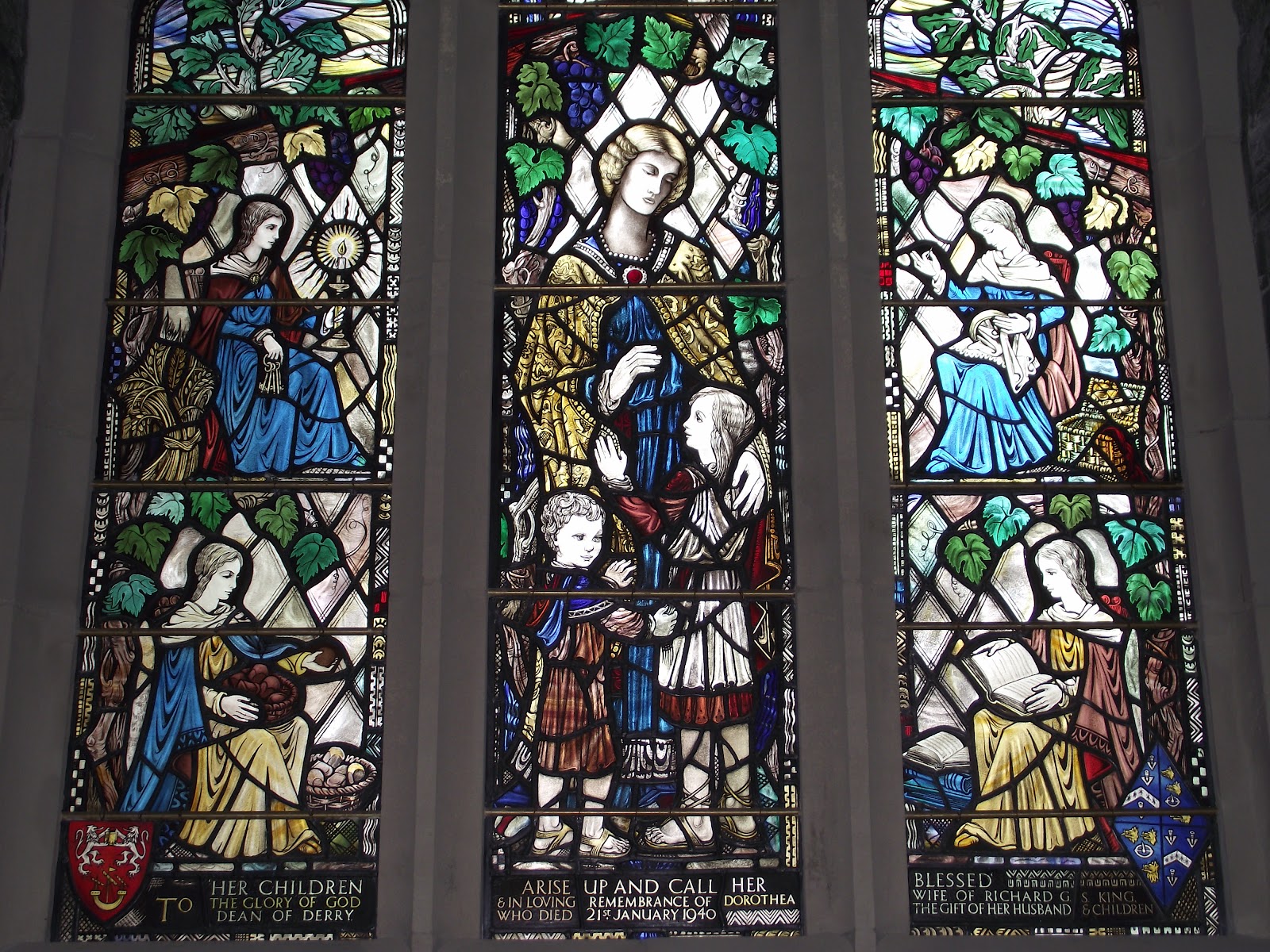
The font is dated 1747. The stained glass window in the west wall commemorates Dorothea, wife of the Very Rev. Richard King, Dean of Derry, 1921-1946.


The window in the north commemorates Mrs Alexander, and depicts some of her hymns.


The tiling in the baptistry was presented by the Right Rev. Joseph Irvine Peacock, Bishop of Derry and Raphoe from 1916 to 1945. There is a lectern with the navel crest of Sea Eagle, and a lovely tile and mosaic monument which has inscribed upon it, a prayer for the cathedral by Mrs Alexander.


There is a monument to the Rev. Robert Higinbotham, Curate of Templemore from 1850.


He is also commemorated  by the font in the north-west corner of the nave, the cover for which was presented by the branches of the Girls' Friendly Society of Derry and Raphoe in 1887.


To the right of the vestibule, there is a room which was formally the choir robing room, it is now used as an office. It contains a stained glass window which commemorates the Siege of Derry. The window in the vestibule to the left of the office entrance shows Jesus as a child. It was the gift of Mrs M. Macgee. At the entrance to the Chapter House, there is a window which depicts the life of Christ.


The two-storey nave has seven bays and a fine hammer-beam ceiling of 1823. The celestory windows each have three lights and lattice panes. The corbels at the base of the roof support pillars, represent heads of former bishops and deans.


The pew end carvings are all different- no two alike. They were carved by father and son named Alford.


The nave is flanked by north and south aisles. The chancel, with the choir stalls on each side, leads into the sanctuary.


The marble floor in the chancel was laid during renovations in 1925. The carpet depicts coats of arms of the Irish Society, of the See of Derry, and of the Cathedral. On the east wall there are six mosaics, three on each side of the high altar, marble panels below. These mosaics depict the four Evangelists with St. Patrick and St. Columba.


Behind the high altar, there is a fine reredos, the central section of which depicts the Lamb of God. It was presented in 1887 by clergy who had been ordained in the Cathedral. The solid silver altar cross, (not on display when I visited) was the gift of Sir Basil McFarlane, 1966. There are four prayer desks in the sanctuary.

 There is a yellow flag on each side of the east window in the sanctuary. The original flags were captured from the French army during the siege.  On the still of a large window behind the chapel in the south aisle is a large plaque which states that in 1839, the ladies of Derry renewed the banners which had been restored during the centenary of the siege in 1789. The staves are original. The  
other flags in the chancel are the King's Colours of the 8th and 10th Royal Inniskilling Fusiliers. There is also an Ensign which was presented by the Royal Air Force, and there are Canadian and U.S. Ensigns, which were presented to commemorate their naval presence in Londonderry. There are also flags of other regiments, including the Londonderry Regiment.


The pulpit is situated just outside the chancel. It is made of Caen stone and Cork marble, and dates from 1887.


St Columb's Cathedral is lit be some excellent stained glass windows. There are six windows of four lights in the south aisle. Starting from the west, the first of these depicts our Lord in the Garden of Gethesemne. It commemorates Henry McClay, LL.D., who died in 1884.