Limavady, County Londonderry, is an important market town on the River Roe, at the foot of the Sperrin Mountains. The name means "leap of the dog". The parish name of Drumachose means, "the ridge of the rent (or tithe)". The patron saint was Canice who was born in the area about 517 A.D. The Convention of Drumceatt which was held about 575, was attended by St Columba who returned from Iona to be present. The ancient church was at Fruithill in the Drenagh estate, and it's ruins are still visible
.
At the time of the Plantation of Ulster from 1609, Sir Thomas Philips allocated lands in the Roe Valley to the Haberdashers', Fishmongers', and Skinners' Companies. He established a town called Newtown Limavady near the ancient settlement of Ballyclose. It received a charter in 1613.
In the 1622 survey, the church was in ruins. A church was built some time before the 1641 rebellion, but was badly damaged at the same time. In records of 1736, the church is referred to as Christ Church. It was built on the same site in 1750
During major renovations in 1881, the south transept, the chancel, organ chamber, vestry room, and new porch were added to the church, along with several new windows. The old church walls were raised and a new roof was put on. It was consecrated on 1st December 1881.
Drumachose Church has a lofty, four story tower which was built in 1749. The north transept was built in 1824. There is a small circular window in the porch at the base of the tower. Inside is the stairway to the gallery.
A plaque in the porch states that the lighting of the church is in memory of Major J. A. Ritter, R. A. and another plaque states that the bell was electrified in memory of Robert Connor, Rector's Churchwarden, 1954-1966. The table in the porch is in memory of Police Constable Norman Kennedy who died in 1987.
Inside, the church design is cruciform, with nave, transepts and chancel. On the north wall there are three windows with diamond opaque glass and tracery. On the south wall the first window is similar. The second window depicts, on the left St Columba, and on the right, St Canice.
The windows are in memory of Alexander Boyle of Bridge House who died in 1920, and of his wife.
The third window depicts the Ten Commandments on the left, and the new law on the right. It commemorates John, Alfred, and Margaret Ritter, 1950.
The window of the south wall of the transept, there is a window with diamond opaque glass. The window in the south wall of the transept has three lights, and depicts the parable of the Good Samaritan. It is in memory of Samuel Alexander, D.L., of Roe Park, 1887. The window in the east wall of the transept depicts on the left, Christ the Light of the World, and on the right the Raising of Lazarus. It is in memory of Conolly MacCausland, JP, DL, of Drenagh who died in 1902.
In the north transept, west wall, there is a diamond opaque window. The rose window in the north wall of the transept has floral patterns. At it's centre is the Dove of the Holy Spirit. It commemorates Robert Macrory who died in 1890. The window in the north transept east wall depicts the raising of the widow's son at Nain, and is in memory of John Boyle and his mother, Mary Ann, both of whom died in 1890.
The east window has three lights, and shows, in the tracery at the top, the Ascension. Below on the left side of the window are the angels of the nativity, in the middle, Jesus with the children, and on the right the Risen Christ. The windows commemorate William Ross and Mary Ross.
The baptistry is in the north transept. There is a second font in the south transept. The three marble steps up to the chancel are in memory of Fredrick Trench of the London Scottish Regiment who was killed in 1916. The chancel is entered through a splendidly carved stone archway, which has upon it, various celtic figures and symbols. At the apex is a leaping dog, from which Limavady gets its name.
The organ chamber is on the left and the vestry room is on the right. The pulpit on the left is in memory of the Rev. John Olphert, Rector of Drumachose from 1820 until his death in 1851. The brass eagle lectern commemorates Hugh and Mary Lane, 1881. The prayer desk on the left of the chancel is in memory of the Ogilby Family, and the prayer desk on the right is in memory of Samuel Stirling, 1913.

The panelling at the front of the pews in the south transept is in memory of Conolly MacCausland and his wife, the Hon. Laura St.John 1828-1919. The panelling in the chancel and the sanctuary is very fine. It extends to form a canopy over the vestry door, and altogether it was carved by the Rev. Richard King, Rector 1904-1921, who became Dean of Derry. The Lord's Prayer is carved on the section of the panelling by the organ chamber. The altar is particulary finely carved, and it commemorates Dean King's son, Robert, of the Royal Dublin Fusiliers, who was killed at Ypres in 1915. The cross on the altar was carved in 1967 by another son of Dean King, Major Travers King. The two small prayer desks in the sanctuary were given in memory of Sybil Hunter, 1989. The organ has two manuals and pedals, with a detached console. It was installed in 1881 in memory of Canon (later Dean) Andrew Ferguson Smyly, Rector 1880-1883, and of his wife.
There are several fine memorials and monuments. The monuments commemorating those who fell in The Great War are on the north wall of the nave in three sections. They are of Bath stone, and stand three metres high. The first section contains on the left, a general war memorial, and on the right, a memorial to Samuel Harrison who was killed in 1918.
The second section contains on the left, a memorial to Fredrick Trench who was killed in 1916, and on the right, J. Procter who was killed in 1916, is commemorated.
On the third section section, there are four parts, commemorating James Bearly, 1915, William Predy, 1917, Robert King, son of Dean King, 1915, and Cecil King, who died in 1916. Over the top of each section are the names of The Great War battles, and all who fell are commemorated on a frieze at the base which runs along the whole length of the monument.
In the north transept, west wall, are memorials to Lesley Alexander who died in 1852 and to Robert Ogilby, M.D., 1817, and his wife and daughter.
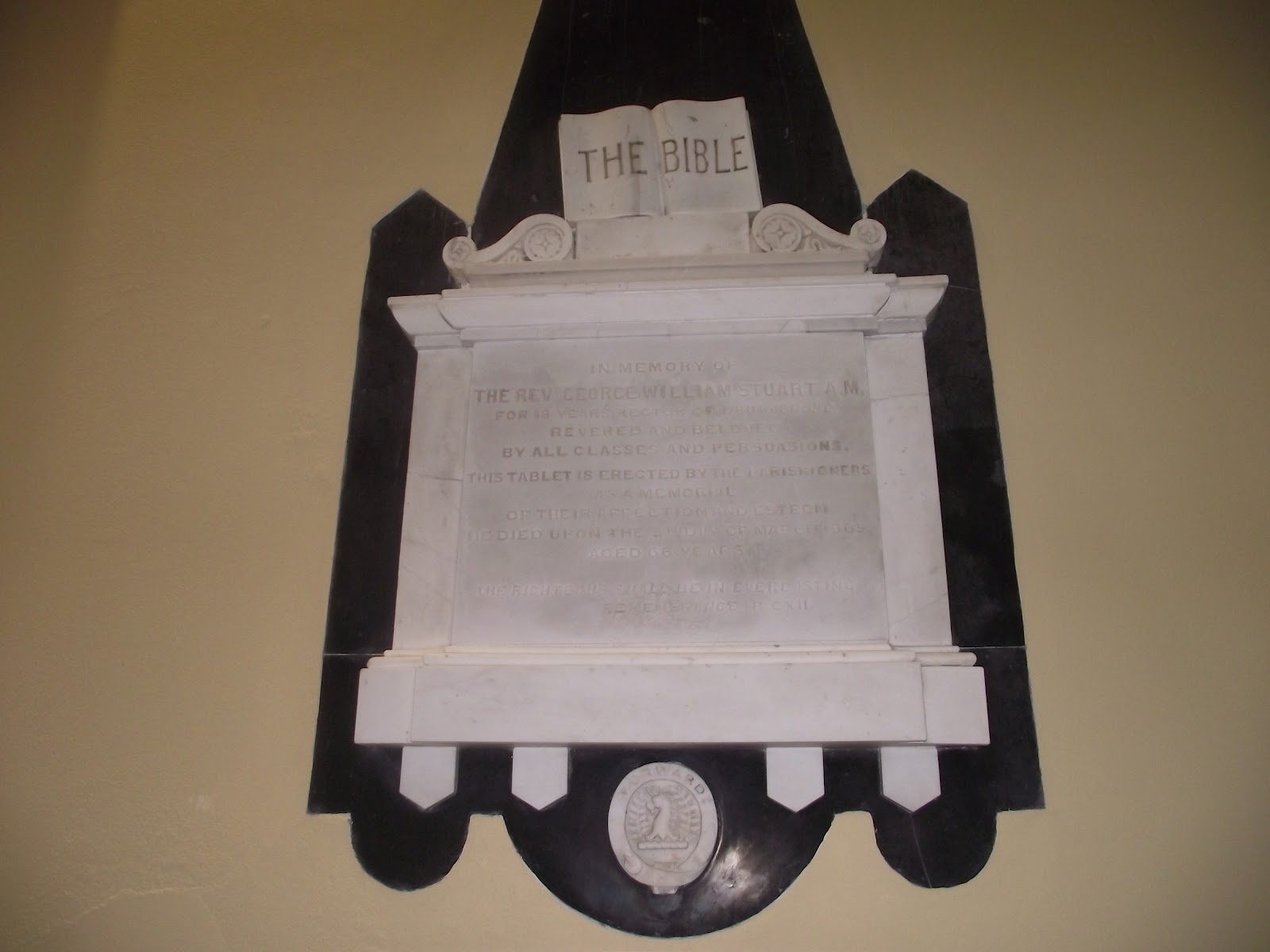
On the north wall of the north transept, Rev George Stuart, Rector 1851-1869, and Rev John Olphert, Rector 1820-1851, are commemorated.
On the east wall of the north transept, Lt. John Olphert R.N., son of the Rector, who died in 1844, and Henry Tyler who built the organ chamber, are commemorated.
In the south wall of the nave, there are monuments commemorating Conolly MacCausland of Drenagh who died in 1902, and Dr. Benjamin Lane, who dies in 1922, Capt. Anthony Boyle, Royal Inniskilling Fusiliers who was killed in the Second World War 1943, and Mary McCausland who died in 1790. On the west wall are memorials to Dr Stanley Monck, Archdeacon of Derry, and Rector of Drumachose, 1751-1768, who died in 1785, and to Edward Boyle who died in 1925.
In the south transept, east wall, Samuel Maxwell Alexander, JP., DL, who died in 1886 is commemorated.
There is a memorial to Thomas Flemming who died in 1890, and to Catherine King who died in 1865. On the south transept, south wall are memorials to Alexander Alexander who died in 1832, and to John Campbell who died in 1821, and to his wife.
On the west wall of the south transept, John Moody who died in 1840, Marion, daughter of Henry Taylor, who died in 1843, are commemorated.
To the left of the north transept, there is a suite of rooms which were dedicated in 1967 in memory of Canon Douglass White, Rector 1936-1963. These contain a room which is both used as a chapel for daily services, and a choir practice room. The stained glass window is in memory of Norman Simpson, organist of Drumachose for many years.
The parish halls were built close to the church in 1969. Miss Jane Ross, who discovered and preserved the famous tune,"The Londonderry Air", is buried in the graveyard.