Showing posts with label St Patrick. Show all posts

Wednesday, 5 September 2012

Cumber Upper, Alla, Claudy


The name Cumber comes from the Irish, com, together, and boir, water, so the name suggests the meeting place of two waters, the Rivers Glenradle and Faughan, in the vicinity of the village of Claudy, some thirteen kilometres east of Londonderry, just to the south of the main Belfast road. According to tradition, St. Patrick founded a church in the area. In 1622, the church was ruinous. It was in reasonable condition by 1693, and was rebuilt in 1757. The parish was divided into Cumber Upper and Lower in 1798.

Cumber Upper Church at Alla, two kilometres south of Claudy, was built in 1860. It is a three bay hall with a north aisle. The lean-to and gabled porch is in the south wall, and the tower is in the corner of the south and west walls. The copper spire was erected in 1960. Inside the porch there are stairs into the gallery, below which are the vestry rooms. These rooms, as well as the public address system and the rose window in the west wall, were donated by the Robinson family in memory of John and Annabella Robinson, 1995. There is another vestry room at the east end of the aisle. In the porch, the window commemorates Robert McFaul, a constable in the Royal Ulster Constabulary who died in 1984, and there is a plaque in memory of George and Jane McFaul.


There is a window of three lights and diamond glass in the west wall, with a rose window above. The first window illustrates Christ, the Light of the World, standing at the door and knocking, and is in memory of Samuel and Eileen Eakin, 1991. The second window has diamond opaque glass, with an inset illustrating the text, "and a little child shall lead them". It commemorates Kathryn Alexandra Eakin, ages eight years, who was killed in a bomb blast in Claudy in 1972. The window in the west ailse wall came from St. Nicholas' Church, Castlerickard in the Diocese of Meath, which was closed. It illustrates the text, "It is I, be not afraid", in memory of Richard Vernon Kellet. It was installed in the church in memory of James Whiteside, James McFaul, and Samuel Craig, 1979.


The baptistry is in the north aisle. The window in it shows Jesus welcoming the little children, and it is in memory of Paul Robinson, aged two years, 1964. The middle window in the aisle shows the raising of Lazerus, and it is in memory of John Robinson who died in 1964. The third window was installed in 1994, it shows on the left the text, "peace, be still", in memory of Joseph and Annie Haire, and on the right, Jesus giving a blessing, in memory of Annie Bonner who died in 1971.


There are three window in the sanctuary, which has three sides. The first window has, Ave Maria, gratia plena, Hail Mary full of Grace, the second has, Ego sum Pastor Bonus, I am the Good Shepherd, and the third has, et Verbum caro factum est, and the Word became flesh. The windows are in memory of Mary, wife of Charles Robinson, and daughter of Canon John Beckett, Rector 1905-1943.


The altar, the reredos and credence table were presented by Claude Braddel in memory of his wife Eileen, 1959. In the chancel, the prayer desk on the right was given in memory of Robert and Jayne Forsythe, 1959, and the prayer desk on the left, in memory of Edith Leslie, 1990. The pulpit on the left of the nave was erected by Ernest Browne and Constance Browne in memory of the Browne Family of Cumber House, 1938. There is a brass eagle lectern. A new organ was installed in the aisle, 1999. The detached console of two manuals and pedals is to the right of the nave.

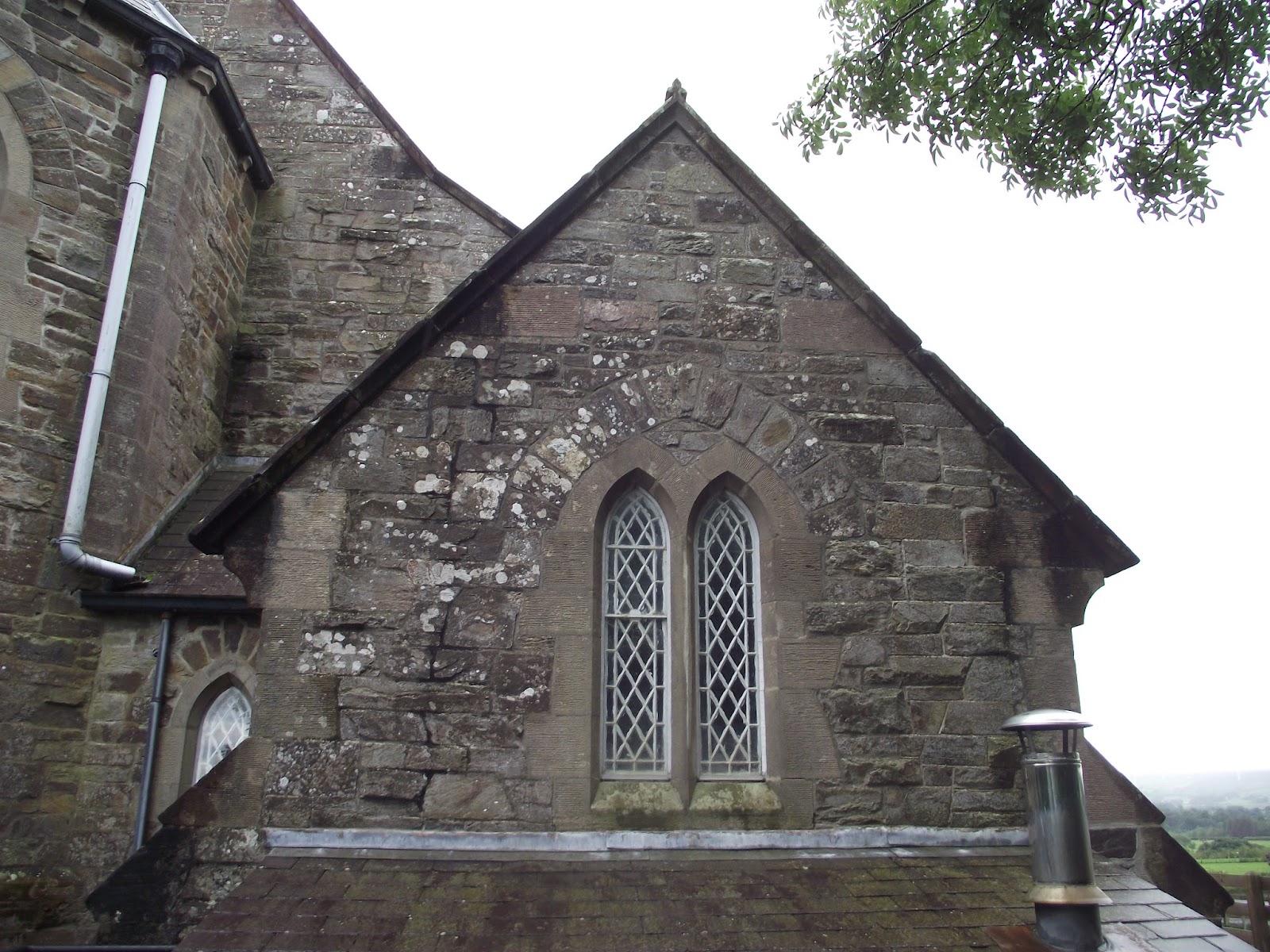

A brass monument on the south wall commemorates Flight Sgt William Harkness, RAF, who was killed in 1943, and a memorial records the life of the Rev. Thomas Lindesay, Prebendary of Cumber, 1847-1860. On the north aisle wall, there is a memorial to Canon John Beckett who died in 1949, and to his wife Violet who died in 1942. It was presented by their daughter, Dorothea Harvey in the church's centenary year, 1960.


Saturday, 28 July 2012

Christ Church, Castlerock


Castlerock is a seaside resort on the north coast of County Derry. The parish was created out of neighbouring Dunboe as a perpetual curacy in 1867. The church, one of the most beautiful in the Diocese, was built between 1867 and 1870 from endowments granted by Sir Henry Bruce and the Clothworkers Company. The Clothworkers Company had been established in the area at the time of the Plantation of Ulster at the beginning of the 17th century.

The Hervey Bruce family was prominent in the area. They lived at Downhill House, just east of Castlerock, which had been build by their ancestor, the Hon. Frederick Augustus Hervey (1730-1803), the Earl Bishop of Derry 1768-1803. Bishop Hervey was a notable traveller, and he built several churches in the Diocese. He was also responsible for the building of Mussenden Temple at Downhill on a cliff overlooking the Foyle.


Christ Church, Castlerock, was consecrated by Bishop (later Primate) William Alexander. For the occasion his wife, Mrs Cecil Francis Alexander, wrote a hymn, which was set to music by Canon James Armstrong, first vicar of Castlerock. The porch in the north-west corner is at the base of the tower. The tiling in the porch is in memory of Robert Nicholl who dies in 1984. The tower is capped by a spire, at the base of which is a clock with four faces. It was built in 1909. The peal of eight bells dates from 1891. They are a memorial to Sir Hervey and Lady Bruce.

The church is cruciform with transepts, chancel and a three sided sanctuary. The interior is of a deep red brick, which creates a warm and solemn atmosphere. Over the entrance door are the words "depart in peace". The west window is of three lights. It commemorates Dame Mary Anne Margaret Bruce, daughter of Sir L. G. Clifton, Bart., of Clifton Hall, Nottingham, and wife of the Rt. Hon. Sir Hervey Bruce, Bart., of Downhill who died in 1891. It depicts scenes from the parable of the Sheep and the Goats. The font is ar rge base of the window.


There are three stained glass windows in the south nave wall. The first, dated 1918, depicts St Patrick and St Columba, and marks the fiftieth anniversary of the incumbency of Canon James Armstrong, first vicar of Castlerock, from 1868.


The middle window depicts Melchizedek and Eilijah and is in memory of William Armstrong who died in 1860, and the third depicts Aaron and Samuel, in memory of Frances Armstrong, who died in 1883.


The three windows in the south transept wall illustrate the theme of Jesus' favour with God, and the Ascension, and they commemorate Col. Robert Bruce who died in 1899.


The three windows in the north transept depict the sower, the Light of the World, and the Good Shepherd, and are in memory of the Rt.Hon. Sir Hervey Bruce, Bart. of Downhill who died in 1907. The north nave wall, the two windows depict Mary and Joseph at the Manger, in memory of Andrew Mitchell who died in 1974, and Jesus with the little children in memory of Robert Stanage who died in 1911, and his family.

There are three windows of two lights each in the sanctuary. The outer ones of finely coloured glass, and the central window depicts the Ascension on the left, and on the right the Empty Tomb. It commemorates General Sir Arthur Benjamin Finton, K.C.H.


The vestry room is to the left of the chancel, and the organ chamber is opposite. The organ, which has two manuals and pedals, was built by the firm of Grey and Davidson in 1870 to a design of Canon Armstrong. The original water pump for the bellows, now restored, is on display in the church. The pulpit was the gift of Sir John Musgrove, Bart., a member of the Clothworkers' Company, 1870. There is a prayer desk on each side of the choir. The lectern on the right was presented by William White in 1870. The wooden cross behind the altar came from the crypt of St Martin-in-the-fields, London. It commemorates the Rev. Charles ffolliott Young, Rector, 1948-1959. The words, "Holy, Holy, Holy, Lord God Almighty which was and is to come", are painted over the sanctuary. The stencil work and fleur-de-lys patterns in the south transept are thought to have been painted by Canon Armstrong. There are elaborate brass candelabra.


On the west wall, a brass memorial to Lady Bruce who died in 1891, states that the peal of bells was given in her memory. A plaque records the munificence of Miss E. K. Stinson who died in 1987, and there is a memorial to William George Simpson who died in 1985, in whose memory the entrance doors were errected in 1987. 


A brass memorial on the north wall commemorates Samuel Carson, RN, of Downhill who drowned at Madras, India in 1948. The memorial to those who fell in the Great War is also on the north wall. In the north wall transept, there is a memorial to the Rt.Hon. Sir Hervey Bruce, Bart.


Parish of Dunboe, St Paul's Church, Articlave


Dunboe, "the fort of the cow", is a parish on the north coast oh County Derry, eight kilometres to the west of Coleraine. The Patron Saint was Adamnan. St Patrick visited the area, and found that Christianity had already been established, possibly by Scottish settlers. In medieval times the, the parish was permanently linked to the Archdeaconry of Derry.

The Clothworkers'  Company established the Plantation village of Articlave in 1618-1621. In 1622, the church was reported to be in good order, having been repaired by them. The old church, being distant from the new village, was abandoned. It's ruins can still be seen to the west of Articlave. The present Church was built in 1691. This was extended by the addition of a pinnacled tower at the west end some time around 1800.


Between 1821 and 1825, the walls were raised, the chancel was built, and a vestry room was added to the tower. The sundial in the south wall was installed in 1823. On it is the inscription, "Tis greatly wise to talk with our past hours, and ask what report they bore to heaven" The windows in the north wall, and gallery, were added in the 1830s.


St Paul's Church is entered through a door in the south-west corner, which is in memory of Jane and Robert Johnston, 1991. There is a small round window over the door. The vestry door is in memory of Jonathan Wilson, 1991.


Inside, the church is a three-bay hall, with the gallery over the west end. The Baptistry is in the south-west corner. The pulpit on the left, the altar and reredos were all installed for the tercentenary celebrations of the church on the 2nd June 1991. The lectern and organ are on the right side of the nave. The chairs in the sanctuary were the gift of Mrs Macafee in 1953.

The three windows in the north wall each have diamond-paned glass with coloured insets. The first window depicts a Bible and a candle, the second, a lion and lamb, the third, a cross and crown. On the south side, there are also three windows. The first by the entrance, has opaque glass. The middle window has an inset depicting the stoning of St Stephen, and is in memory of Mr and Mrs W Kennedy, 1991 and the third window depicts St Paul in Athens in an inset, and commemorates Robert and Elizabeth Warke, 1991.


The east window has three lights and tracery. The middle section depicts St Paul in Miletus (Malta). The window commemorates James Coleman who died in 1934.

The memorial to those who gave their lives in the Great War is on the south wall. On the north wall, there is a memorial to Alexander Coleman who died in 1898, and to his wife and family. A brass plaque on the wall of the baptistry records renovations to the church for the tercentenary celebrations in 1991, which were made possible by a bequest from Miss E. Stinton.


Tamlaghtard, St Cadan, Benevenagh


Tamlaghtard,  "the high plague monument ", is situated on an exposed, windswept site, on the slopes of Benevenagh Mountain, overlooking the Magilligan peninsula at the north-eastern tip of Lough Foyle. The church is said to have been founded by St Patrick. Patrick's work was continued by the patron saint of the parish, Cadan, who lived around the beginning of the sixth century, and whose tomb is supposed to lie close to the old church. The ruins of this church are adjacent to St Aidan's Roman Catholic Church nearby, the site of which was given to their congregation by the Earl Bishop when Tamlaghtard church was built.  


The exact date of the present church is uncertain, but it was built between 1778 and 1787, with assistance from the Earl Bishop. It is a simple three bay church with a tower, through which the church is entered. At its base is a flight of steps, and on both sides, there are two smaller towers, which are, in fact, extensions to the nave, and of the same height.


On the north wall, and on each of the tower entrance, are blind windows. There is a window in both of the miniature towers at the west end, and three windows of two lights and Y tracery in the south wall of the nave. The east window has three lights and tracery.

Inside the porch are the stairs to the gallery. In the nave, the baptistery is in the south west corner beneath the gallery. The chancel and vestry room to the left was built in 1854.


The stone pulpit is to the left. The prayer desk on the right is in the memory of Sir Fredrick William Heygate, DL who died in 1894, and the wooden eagle lectern adjacent commemorates the Rev John McAdams, Rector of Tamlaghtard, 1670-1899.


In the sanctuary, the reading lights commemorate Sir Henry McDonald Tyler and his daughter, 1980, and the prayer desk was presented by the Rev. Robert Stanley, Rector, 1954-1960, and Mrs Stanley.

Tamlaghtard has some fine monuments and memorials commemorating the Heygate, MacCausland, Gage and Tyler families. On the north wall is a monument to Sir John Heygate, 4th Baronet, of Ballerina, and second son of Arthur Conolly Gage. There is a memorial to Connolly MacCausland of Drenagh who died in 1827. The section below commemorates Marcus MaCausland who died in 1862, and below again, a part of the memorial commemorates Marianne MaCausland who died in 1864. There are memorials to Ann Gage who died in 1868, and to husband Marcus Gage who died in 1890. Henry Tyler who died in 1897, and his daughter who was the wife of Canon Henry Francis McDonald Tyler, Rector of Tullyaughnish (Ramelton), and Conolly Gage of Ballerena, and his wife Henrietta, who died in 1869 are all commemorated.


Monuments commemorate Col. Robert Henry Gage Heygate, DSO who died in 1923, and Sir William Fredrick Heygate, DL, who died in 1894, and Marianne, daughter of Conolly Gage of Ballerina, wife of Sir Fredrick Heygate, and the Rev. Thomas Thomson, LL.,D., Rector 1931-1928.


On the east wall are the memorials to Eliza Dysart who died in 1871, and to her husband the Rev. William Dysart, Rector of Tamlaghtard, 1856-1874, and who died in 1881. On the south wall, there is a memorial to Christopher Gage Heygate who died in 1905, aged twelve years, and Conolly MacCausland of Fruithill (the old name of Drenagh), who died in 1794, and his wife, are commemorated.


View of Bellarena Presbyterian Church from Tamlaghtard Church of Ireland. Lough Foyle in the background.